

The introduction of the Nigerian Electricity Regulatory Commission's (NERC) Net Billing Regulations 2026 marks a significant milestone in Nigeria's energy transition.
For the first time, eligible electricity consumers can export excess renewable energy generated from their systems to the grid and receive credits on their electricity bills.
The regulation is designed to encourage the adoption of distributed renewable energy, improve grid resilience, and enable consumers to play a more active role in the electricity market. However, amid the excitement, one question continues to emerge
Does this mean solar users can now generate meaningful income by selling electricity back to their Distribution Company (DisCo)?
The answer is more nuanced than many people expect.
Understanding Net Billing
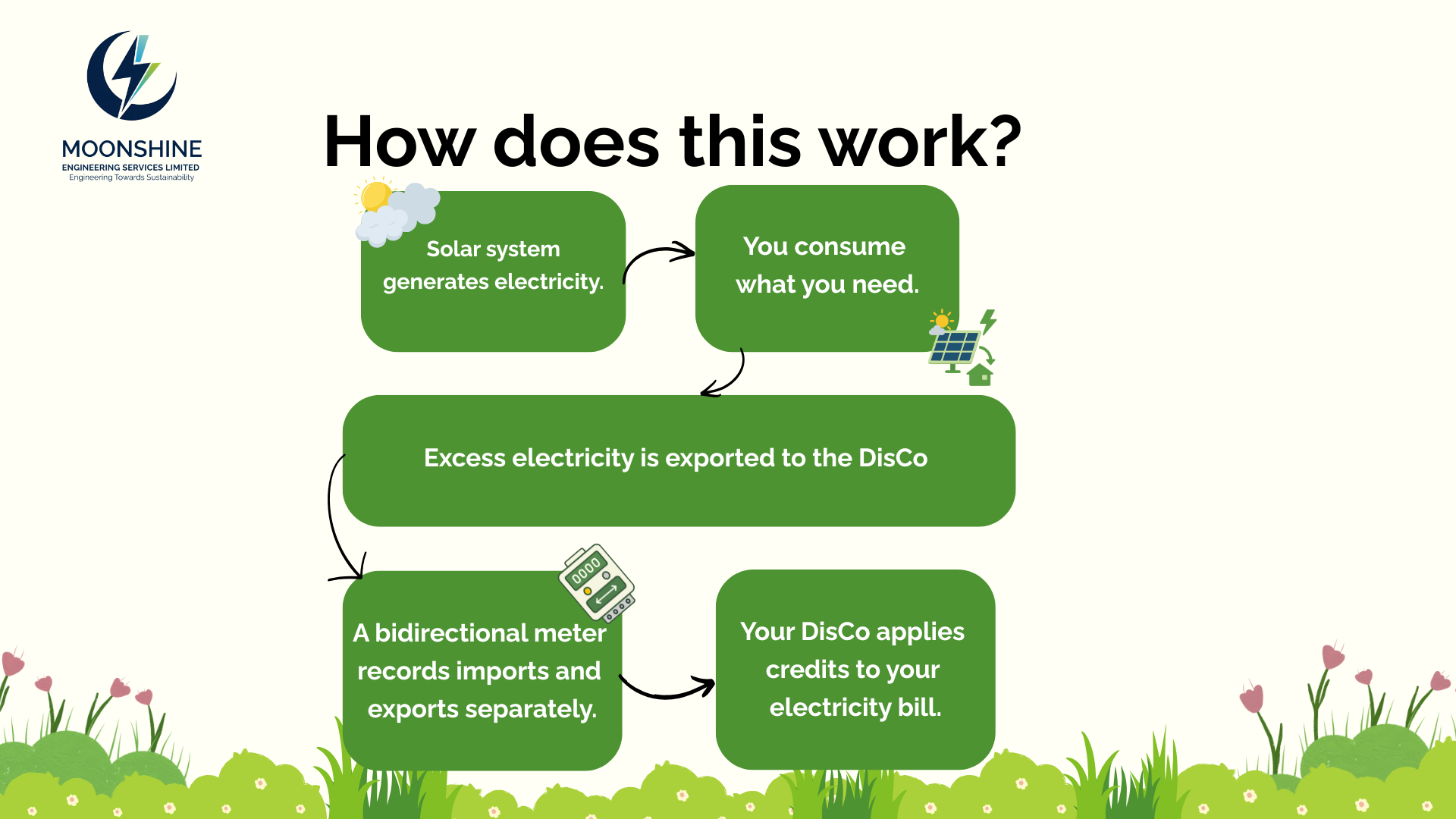
Net billing is a mechanism that allows eligible customers with renewable energy systems, such as solar photovoltaic (PV) installations, to export excess electricity generated on-site to the distribution network.
When a customer's renewable energy system generates more electricity than is immediately consumed, the surplus energy is exported to the grid through an approved bidirectional meter.
The amount of electricity exported is measured separately from the electricity imported from the grid. Customers receive bill credits based on an approved export tariff, which can be used to offset future electricity costs.
These credits are then applied to future electricity bills.
Net Billing Is Not Net Metering
Although the terms are often used interchangeably, net billing and net metering operate differently.
Under net metering, each unit of electricity exported to the grid offsets one unit of electricity imported from the grid. In effect, exported electricity is valued at the same rate as purchased electricity.
Under net billing, imported and exported electricity are accounted for separately.
Exported energy is compensated at a NERC-approved export tariff, which is expected to be lower than the retail tariff consumers pay for electricity.
This distinction is important because it fundamentally changes the economics of system design.
Understanding the Financial Implications
Export tariffs under the Net Billing Regulations are determined using NERC's Multi-Year Tariff Order (MYTO) methodology.
The methodology considers several factors, including energy costs, network charges, and system operation requirements.
As a result, the value of exported electricity is expected to be lower than the cost of electricity purchased from the grid.
Consider a simple example:
- Import tariff: ₦250/kWh
- Export tariff: ₦120/kWh
Every kilowatt-hour consumed directly from a solar system avoids a ₦250 electricity cost.
Every kilowatt-hour exported to the grid earns a ₦120 credit.
The implication is clear: the greatest financial value comes from self-consumption, not exports.
For most participants, net billing should be viewed primarily as a mechanism for reducing electricity costs rather than generating additional revenue.
Who Can Participate?
Participation in the net billing programme is subject to regulatory, technical, and operational requirements. Participation is open to eligible customers who:
- Are connected to a licensed DisCo network.
- Install an approved renewable energy system.
- Meet applicable technical and safety requirements.
- Complete technical and network impact assessments.
- Execute a Net Billing Agreement.
- Install an approved bidirectional meter.
- Satisfy NERC registration requirements.
Participation is also subject to available network hosting capacity. Applicable renewable energy technologies, system capacity thresholds, and additional eligibility conditions are defined by NERC.
Why the First-Come, First-Served Approach Matters
Each distribution feeder has a limit to the amount of distributed generation it can safely accommodate.
Once this hosting capacity is reached, additional applications may be delayed or restricted until network upgrades are completed. This means that participation in the programme is expected to operate on a first-come, first-served basis.
As distributed energy adoption increases, understanding local network constraints will become increasingly important.
Metering Requirements
Net billing requires the use of approved bidirectional meters. Traditional unidirectional meters measure only electricity flowing from the grid to the customer.
Bidirectional meters measure electricity flowing in both directions:
- Electricity imported from the grid.
- Electricity exported to the grid.
Accurate measurement is essential for applying export credits and ensuring transparent billing.
Without an approved bidirectional meter, participation in the net billing programme is not possible.
What This Means for Distribution Companies
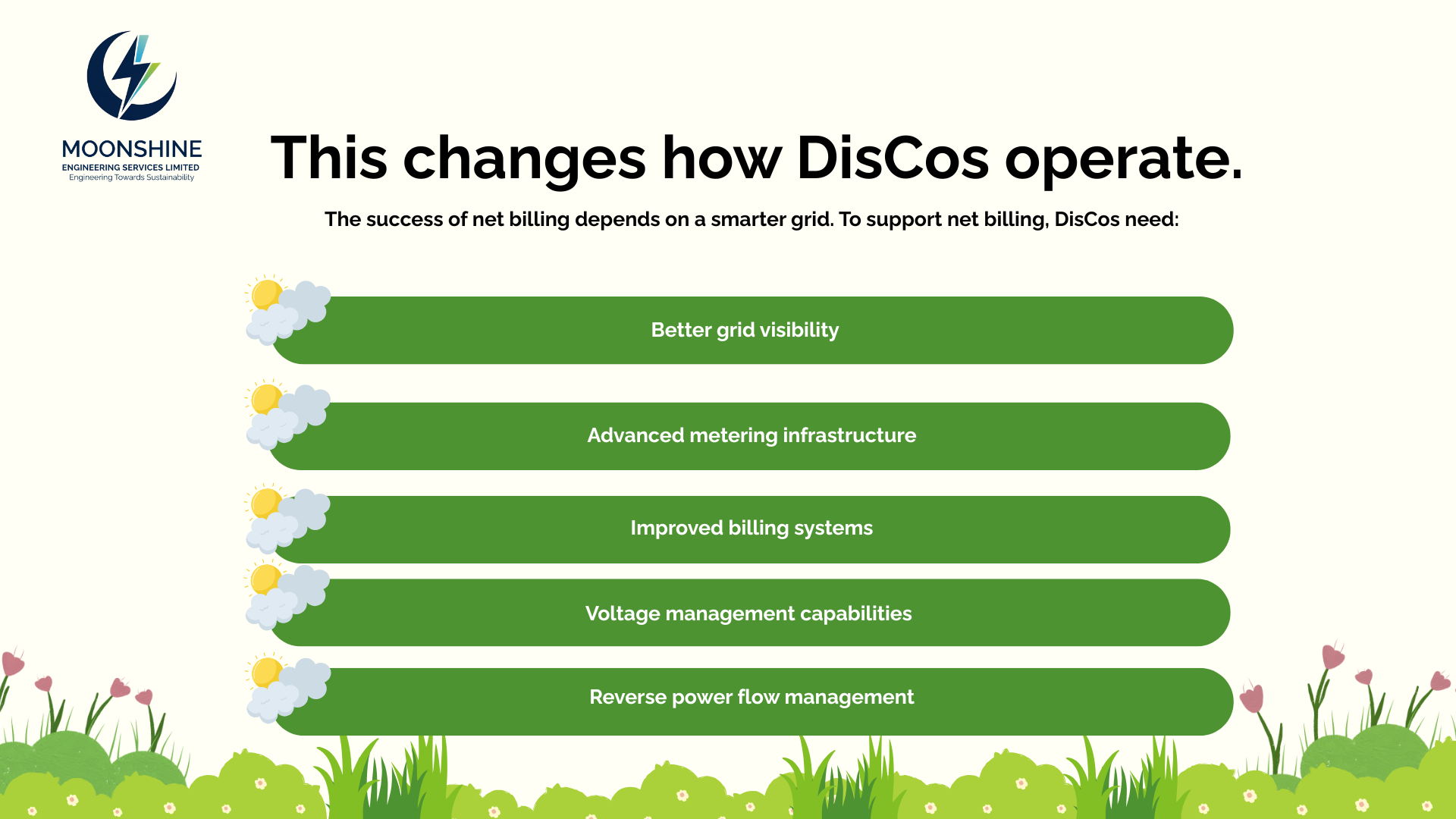
Net billing introduces new responsibilities for DisCos. Supporting higher levels of distributed generation will require investments in:
- Advanced metering infrastructure.
- Enhanced billing systems.
- Improved grid monitoring and visibility.
- Voltage management capabilities.
- Reverse power flow management.
- Long-term network planning.
The effectiveness of the programme will depend not only on consumer adoption but also on the ability of DisCos to modernise their networks.
Why Proper System Design Matters More Than Ever is a title
The introduction of net billing may encourage some consumers to install larger systems with the expectation of earning significant returns from energy exports.
However, oversizing a renewable energy system without understanding consumption patterns, export potential, and applicable tariffs can negatively affect project economics.
The objective should not be to install the largest possible system.The objective should be to install the right-sized system.
This requires detailed analysis of:
- Energy consumption profiles.
- Load patterns.
- Export opportunities.
- Grid constraints.
- Tariff structures.
- Return on investment.
The objective should not be to install the largest possible system, but to install the right-sized system. A comprehensive technical and financial feasibility study remains the foundation of every successful renewable energy project.
Bottom Line
NERC's Net Billing Regulations 2026 represent an important step towards a more decentralised and sustainable electricity sector in Nigeria.
They create new opportunities for consumers to reduce energy costs, improve energy resilience, and participate more actively in the power market.
However, the greatest value from renewable energy investments will continue to come from self-consumption rather than energy exports.
Before investing in a renewable energy system, consumers should understand the technical requirements, financial implications, and grid limitations associated with net billing.
At Moonshine, we support clients through detailed feasibility studies, energy modelling, grid assessments, and financial analyses to ensure renewable energy systems are designed for optimal performance, regulatory compliance, and long-term value creation.